
The Story of Brook Hall
(Ottershaw Village Hall)
in World War Two
Prepared to commemorate
Victory in Europe Day
8 May 1945
on the 75th anniversary
8 May 2020
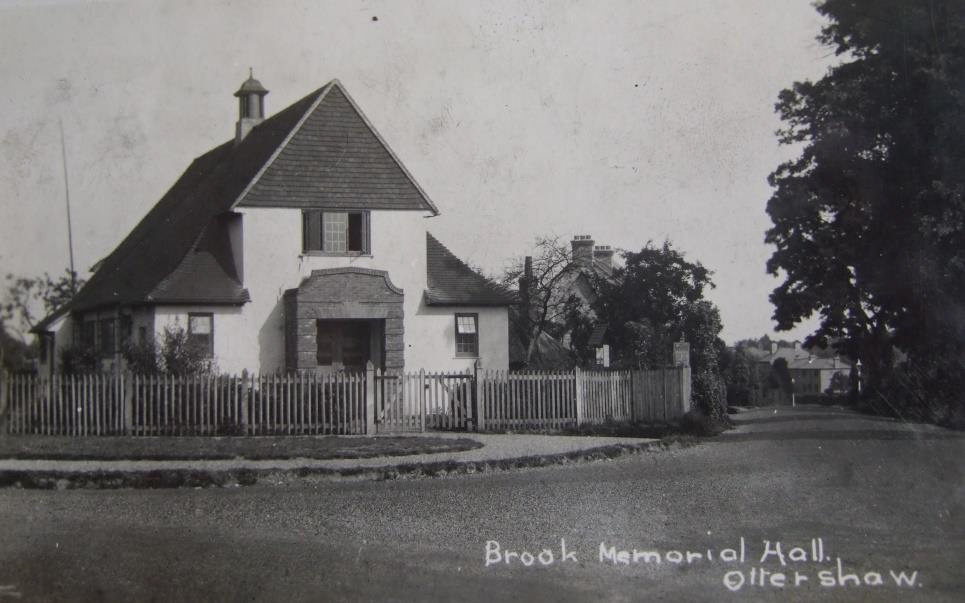
(Picture courtesy of Hannah Lane)
Prepared by
Sheila Binns, Steve Bristow and Julia Williams
(Trustees and committee members of the Ottershaw Village Hall Management Committee)
© Ottershaw Village Hall
May 2020
Introduction
This story has been pieced together from contemporary articles that appeared in the Surrey Herald (the local newspaper), accessed at Surrey History Centre and from extracts from the minutes of Christ Church Parochial Church Council (PCC) meetings, Christ Church Annual Parochial Meetings (APM), Ottershaw Church News (the parish magazine) and other contemporary documents from the archive of Christ Church, Ottershaw. Research was originally undertaken to form the basis of a display at the special May Fair on Friday 8 May 2020. The May Day holiday had been moved from Monday to Friday to coincide with the commemoration of 75 years since Victory in Europe Day in 1945. However, the spread of the coronavirus Covid-19 led to the cancellation of all public events. One more research session had been planned but the closure of Surrey History Centre because of the pandemic made this impossible. The story could be completed, however, with material from the minutes of Church meetings and from the parish magazine. Having gathered the information, but not able to use it for a display, the Ottershaw Village Hall management committee decided to publish the story electronically by email, as their contribution to the commemoration of VE Day. We hope you enjoy reading it.
This is a short synopsis of the story but for those with a little more time and interest the full document that can be downloaded at the bottom of the page. The information gathered tells the dramatic story of Brook Hall during the Second World War. Owned and then managed by Trustees appointed by the Church, it was the Church Hall and the village’s social centre. It had opened in 1930, its construction largely funded by a bequest.
Although it has now been considerably extended and modernised, this Hall, rebuilt against considerable odds during the War, remains our (normally) much-used village hall, now known as Ottershaw Village Hall.
Synopsis
Ottershaw Village Hall is owned by Christ Church, Ottershaw and until 2008 it was run by Trustees appointed by the Parochial Church Council (PCC). It is now a charity run by independent Trustees representing village organisations or elected at the charity’s Annual General Meeting.
The Hall was originally known as Brook Hall, erected to be a Church Hall, through a benefaction to the Church by Miss M L Brook. In common with similar buildings elsewhere, rumblings of war led to an agreement that the Hall could be requisitioned for war purposes, should the need arise.
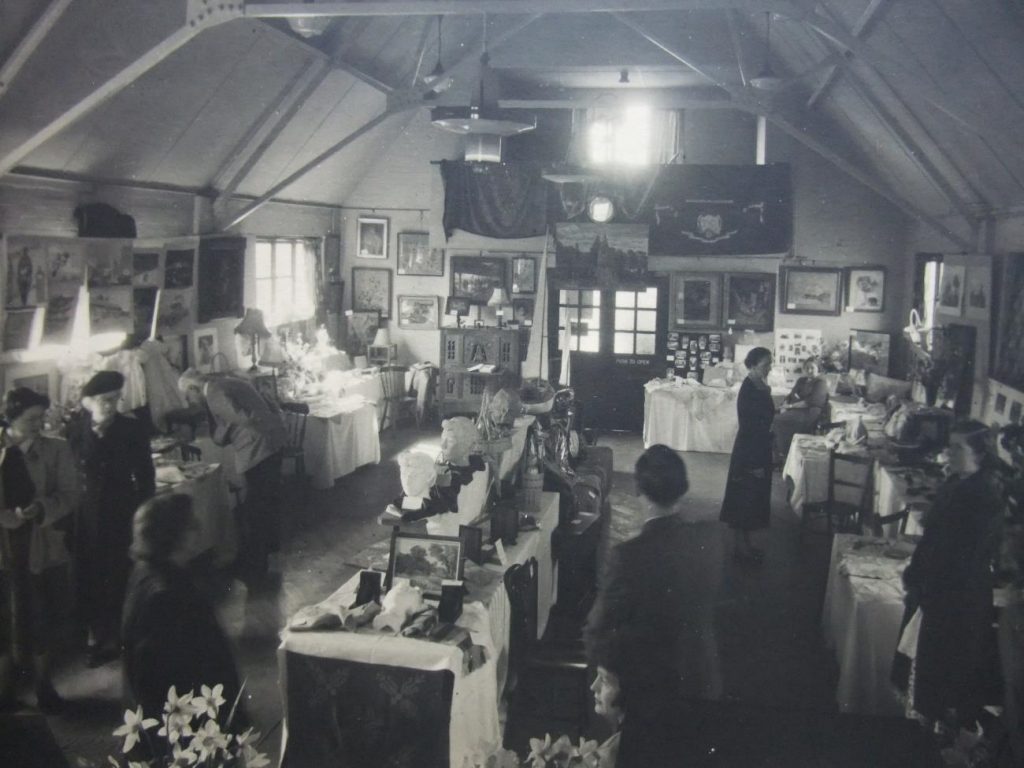
(Picture courtesy of Hannah Lane)
On 3 September 1939, the Prime Minister Neville Chamberlain declared that Britain was at war with Germany. The Brook Hall was formally handed over for the use of Chertsey Urban District Council during the emergency. Initially, the Hall was not be used other than for war-time purposes but as soon as 1940, local people were permitted to use the Hall for social purposes on a limited basis. Chertsey UDC later sought permission from the Trustees to erect two garages on the Brook Hall site to house fire fighting appliances.
Fire!!
The Brook Hall was destroyed by fire between 10.00 pm and 11.00 pm on Sunday 26 April 1942. The investigation into the cause of the fire and the damage caused was the subject of detailed reporting by the local newspaper, the Surrey Herald. Liability for the fire was disputed. When the lease between the Church and Chertsey Urban District Council had been drawn up, the Church had agreed to keep the premises insured against damage by fire during the tenancy. The Council therefore refused to accept liability for the fire and its consequences.
About six months after the fire, new information made it clear that the fire had resulted from negligence on the part of one of the National Fire Service personnel. Nonetheless, it is apparent that the public bodies sought to avoid liability for the fire and consequently the responsibility of reparations, despite the fire being the result of the negligence of a public servant. The Council even apparently withheld information regarding the cause of the fire.
Despite accepting no liability, Chertsey UDC was prepared to reimburse the costs of salvage ‘as a matter of grace’. The Home Office, however, did not support this offer and also refused to provide the police report on the circumstances of the fire. A temporary building was proposed, so that the Chertsey UDC would have a building to use. However, the Hall Trustees were unenthusiastic and refused to agree that the cost of such a building should fall on the Church.
The Home Office seems to have grown weary of local wrangling and withdrew from any intention to use the Brook Hall site but offered half the cost of salvage to Chertsey UDC. Nonetheless, even though it was now clearly established that the fire had been caused by an employee of the National Fire Service, the Home Office still accepted no liability – but apologised for the manner in which the investigation of the fire had been conducted. Support grew for the rebuilding of the Hall, despite wartime difficulties.
Home Office officials visited Ottershaw and became more willing to help. It was agreed that the Hall should be rebuilt, at least partly to be a fire station in the village. The Trustees were not prepared to have a temporary building and, seemingly emboldened by the change of attitude on the part of the Home Office, pressed for an enlarged kitchen to be added to any new building, as well as provision for an extension at a later date.
In the light of a subsequent decision by the Home Office to support rebuilding, the Trustees of Brook Hall were confident in stating their terms and what was acceptable to them. Estimates were obtained for construction, to include enlarging the kitchen and cloakroom facilities. Plans to rebuild took shape and there was a suggestion that the rebuilt hall might become a war memorial.
Insurance monies were insufficient. The Church made a donation to the cost of rebuilding the Hall and a loan was also sought. Building began quickly and, apart from the improvements required by the Trustees, the Hall was rebuilt to the same design as the original building. Just a year after plans had been finalised and estimates sought, the rebuilt Hall opened around the end of April 1945 and the PCC meeting of the 18 May 1945 was held in the newly opened replacement Brook Hall.
On 8 May 1945, Victory in Europe was declared (VE Day).
In summary, the story of Brook Hall during the Second World War was one of disaster, deception and determination. In 1942, a fire due to negligence destroyed Ottershaw’s village hall, which was a great loss to the village. The true cause of the disaster took a while to emerge.
The Hall was only 12 years old when it was destroyed and rebuilding must have seemed a very remote possibility in wartime. Many people must have doubted whether it would ever be rebuilt to serve the village again. However, the tenacity and determination of the Trustees meant that, remarkably, not only was the Hall re-built to an enlarged plan but the whole rebuilding project was completed in a little over a year and before the end of the war. The new Brook Hall almost certainly opened within days of VE Day.